1. First substantive post-Grenfell fire safety judgment: Martlet Homes Ltd v Mulalley & Co Ltd [2022] EWHC 1813 (TCC)
Summary
The claimant building owner (Martlet) sought damages from the defendant building contractor (Mulalley) for remediation costs in respect of combustible external wall insulation rendered cladding, originally fitted on tower blocks by Mulalley between 2005 and 2008, under a 2005 design and build contract for refurbishment works. Additionally, Martlet sought the costs of providing a waking watch until the cladding had been removed.
The cladding included combustible EPS insulation boards, and the claimant also alleged serious installation defects, most significantly the installation of the fire barriers, and Martlet took a decision in 2017 to remove and replace the whole system.
Mulalley argued that its installation breaches in themselves were insufficient to justify full replacement works, but the court held that the defective installation clearly created fire risk and necessitated remedial action. The claimant’s decision to proceed with full removal and replacement was a sensible way of addressing the dual problem of the installation defects alongside the post-Grenfell knowledge that combustible installation was no longer acceptable on these high-rise buildings.
Martlet succeeded in arguing that the cladding did not meet applicable fire safety standards as at the date of the contract, so that replacement and waking watch costs were caused by Mulalley’s “specification breach”. Martlet was also entitled to its waking watch costs “subject to some relatively modest reduction”.
Installation breaches
It was held that there had been breaches in respect of the installation of fire barriers. The failure to ensure that the fire barrier boards and EPS insulation boards had a continuous band of adhesive around their perimeter was a “serious breach”, as it left a continuous void behind the fire barriers. The court was satisfied on the balance of probabilities that cavity barriers “would indeed be reasonably required around windows and service penetrations and at compartment walls for good fire safety related reasons”.
The installation breaches were an effective cause of the loss suffered which led to the decision to replace the cladding, so Mulalley is liable for replacement costs. This was described as “a very good case for an application of the effective cause test for causation in place of the but for test for causation. Otherwise, the claimant would have been forced to make a choice between two equally unpalatable solutions when it was faced with the one problem - the need to take remedial action - caused separately by two unrelated causes.”
Specification breaches
The specification breaches were considered on a “counter-factual” basis, assuming that the cladding system was installed with none of the installation breaches complained of.
The court found that:
Mulalley had breached a contractual obligation in this case to follow the recommendation and advice in BRE 135 (2003) only to install a cladding system which passed the Annex A performance criteria:
BRE 135 (2003) recommended or advised that the default position for a system such as the one used, comprising a combination of combustible thermoplastic EPS insulants and an organic surface render which created an obvious fire risk and a heightened fire risk for high-rise residential tower blocks, was that it should not be specified for use in such buildings unless it had been shown to meet the Annex A performance standard in accordance with the test method set by BS 8414-1.
Although not mandatory, leaving it to individual specifiers on individual projects whether or not to adopt the performance standard, BRE 135 (2003) contained words of “strong exhortation”. The specification of this system, with its own “unique combination of specific materials and its own specific design” involved sufficient variation in material selection and design from existing systems that it was necessary to demonstrate compliance with the Annex A performance standard via a BS 8414-1 test if intended for use in high-rise residential tower blocks. A reasonably competent designer specifier could not have failed to be aware at the time that BRE 135 (2003) contained a clear recommendation and advice to avoid specifying a system like this for a high-rise residential building unless there was evidence that it met the Annex A performance criteria via a BS 8414-1 test.
Mullaley had failed to comply with functional requirement B4(1) of Schedule 1, on the basis that the specified system failed to adequately resist the spread of fire over the walls, having regard to the height, use and position of the building. BBA Certificates issues in respect of the specified cladding system, on which Mulalley sought to rely, could not be taken as a guarantee of compliance with B4(1). The court regarded it as a fair criticism of the evidence of Mr Geddes, the defendant’s architect expert, that ”at times he appeared almost to suggest that it was sufficient for an architect pre-Grenfell to do little more than accept a BBA certificate at face value without the need for much, if any, further investigation”. In the event, although the court accepted evidence from the defendant’s experts that “in the real world professional designers would place great weight on the existence of such a certificate and that this is undoubtedly relevant when considering the case for breach of the “professional negligence” obligation…”, the court did not regard this as having any significant weight as regards the strict design and materials obligations in the contract. As at the date of the design and specification of this system for this project the court was satisfied that “any reasonably competent designer and specifier could not simply have relied blindly upon the 1995 BBA Certificate, since they must have known that matters had moved on since then in terms of the introduction of ADB 2002 and BRE 135 (2003) of which they ought to have been well aware.”
Waking watch costs
The claim for the waking watch costs succeeded in full (in the amounts agreed between the experts, save for a reduction down to one fire marshal rather than two). There was held to be no basis for distinguishing between the fact that without the specification breach there would have been no justification for undertaking the replacement option as opposed to the repair option.
Betterment
The court imposed no discount for betterment such as by replacing the existing EPS insulation boards with mineral insulation boards, since “the real purpose behind replacement as opposed to repair” was to replace the boards as well as the fire barriers.
2. Consultation paper issued on further key new building regulations to support the BSA
The Government has now published an important consultation paper in relation to their proposed way forward regarding the new regimes for the design & construction of buildings, and in particular in relation to:
- The proposed “Dutyholder” roles, competencies and responsibilities in relation to any kind of building work in England;
- The “gateways” and new design and construction regimes for higher-risk buildings in England;
- Comment on enforcement and sanctions for all building work in England;
- Certain proposed wider changes to the building regulations relating to all buildings in England; and
- Transitional provisions proposed for higher-risk buildings issues.
The consultation document outlines the Government’s proposed approach towards these issues and seeks views and comment from industry and the public by way of submission. We provide a brief summary of some key points of interest below. The full consultation can be found here, along with the process for making a submission. Submissions are due by 12 October 2022.
“Dutyholder” and competency requirements applying to all building works
These are proposed to apply to all building work in England to which the Building Regulations apply (i.e. buildings of any height and for any purpose, and not just “higher–risk” residential building work)
The proposed dutyholders are, in essence, to be the client, the designer(s) and the contractors(s), with provision for there to be a principal designer and principal contractor appointed.
The dutyholder roles are relatively broad and at least as summarised in the consultation paper, may create statutory obligations with a strict or absolute liability element in some instances.
The proposed competency requirements are also described relatively broadly in the consultation, but it is noted that the Government has been working with the BSI to produce detailed guidance on competency requirements (which we understand are due to be published in final form by end July 2022). The consultation further makes clear that the Government considers that, if there are schemes set up for assessing individuals’ competency these should be supported by robust assessment processes and third party accreditation arrangements.
There will be additional dutyholder requirements where the building is a higher-risk building.
Among other things, the Government is proposing that, before appointing a person in relation to higher-risk building work the dutyholder making the appointment must enquire as to whether that person has committed a “serious infraction” and/or to consider whether that person’s previous conduct might mean they are not competent.
A “serious infraction” is to be a new test, which the Government proposes is to mean that, within the 5 years preceding the proposed appointment, the person/organisation has (i) been issued with a compliance notice relating to Parts A or B of Schedule 1 of the Building Regulations (BRs) (ii) been issued with a stop notice in relation to a contravention of the BRs; been convicted of an offence under the BSA; the Building Act 1984; the Regulatory Reform (Fire Safety) Order 2005, the Health & Safety at Work Act, or the CDM regulations; or (iii) been the subject of “a finding by a formal inquiry of behaviour that directly resulted in loss of life, the deliberate misleading of customers or amounted to the failure to meet regulatory requirements”.
When applying for building control approval for new higher-risk buildings, declarations will need to be given in relation to dutyholder competencies this information regarding previous conduct must also be provided as part of the competency declarations
in relation to higher-risk building work the dutyholder making the appointment must enquire as to whether that person has committed a “serious infraction” and/or to consider whether that person’s previous conduct might mean they are not competent.
There will be special provisions for building works for “domestic” clients and for non-notifiable works.
“Gateways” regime for higher-risk buildings
The “gateways” regime is presently intended to apply to buildings at least 18m / seven storeys in height with a description that is to be specified in a separate regulation, yet to be published (the Government is proposing that this description be hospitals, care homes or buildings containing at least two residential units; and has issued a separate consultation on this which has just closed).
The Govermment intends to produce detailed new regulations for the building control procedures that will apply to various works, including (i) the construction of a new higher risk building; (ii) building work to an existing higher-risk building (iii) building work to a non-higher risk building such that it becomes a higher-risk building (e.g. change of use or adding floors).
The new regulations will create strengthened oversight and inspection of building regulations requirements and impose various obligations on dutyholders throughout.
New “higher-risk” building work
The process for new higher-risk building work is summarised in the below table produced by the Government in the consultation document:
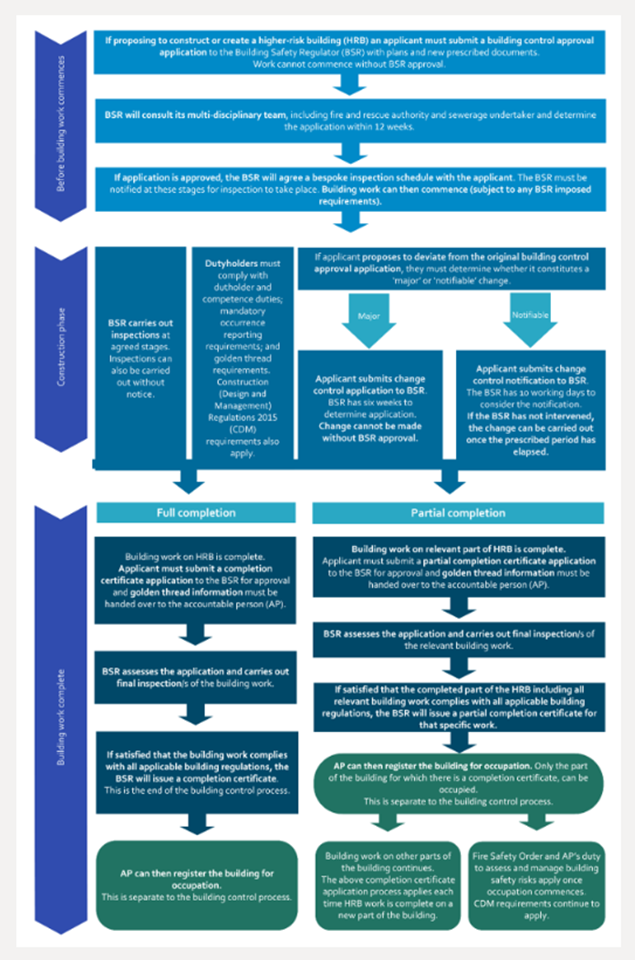
The consultation paper contains a very detailed discussion of various matters relating to the proposed regime for new higher-risk buildings and should be read in full in relation to this section if it is of relevance to you. However, we pick out below a few points below to highlight:
Among other things, the Government is proposing to introduce a specific digital system for the submission of all documents to the Building Safety Regulator (BSR), including in relation to the original applications process; change control, and applications at final completion stage (although there will be a discretion to accept paper documentation if the electronic system cannot be used by an applicant).
A 12 week time frame is proposed between submission of a building control application and a decision by the BSR (or longer if extended by agreement). They further propose that if the BSR has not reached a decision within 12 weeks, and the applicant has not agreed to an extension (or submitted an application to the Secretary of State under a non-determinations procedure) the application will be deemed refused.
Regarding the process for obtaining final BSR certification at completion, the Government notes that it is their intention “for the completion notice and completion certificate application to be made once all the building work has been completed. However, we know that after building work has completed there are sometimes elements that need to be redone (snagging). We therefore consider that the application should be made either after all notifiable work is completed or when all work including snagging is completed and would welcome views on which approach is most appropriate and why”. Again, the proposed time limit between application for a final completion certificate and the date by which the BSR is to reach a decision is proposed to be 12 weeks (and again where the BSR has not made a decision after 12 weeks, but no extension is agreed or non-determination application made, the application will be deemed refused).
It is envisaged that (as currently) issue of a final completion certificate is not conclusive evidence or a guarantee that a building complies with regulations; and that responsibility for ensuring compliance with BRs will rest “exclusively with those carrying out the work”.
Where a project is to relate to both non-higher risk and higher-risk building work, there will be provision for – with the BSR’s agreement – a “regulator’s notice” to be issued stating that the BSR to be the building control body for the entire development (rather than having a local authority separately deal with the non-higher risk building work).
Work to existing higher-risk buildings
The consultation also contains a new section relating to how building work to existing higher-risk building are proposed to be dealt with. This will potentially be of relevance to those who, for example, will be performing remedial works on existing tall residential buildings in future, and a summary table has again been produced in the consultation document, which we replicate below:
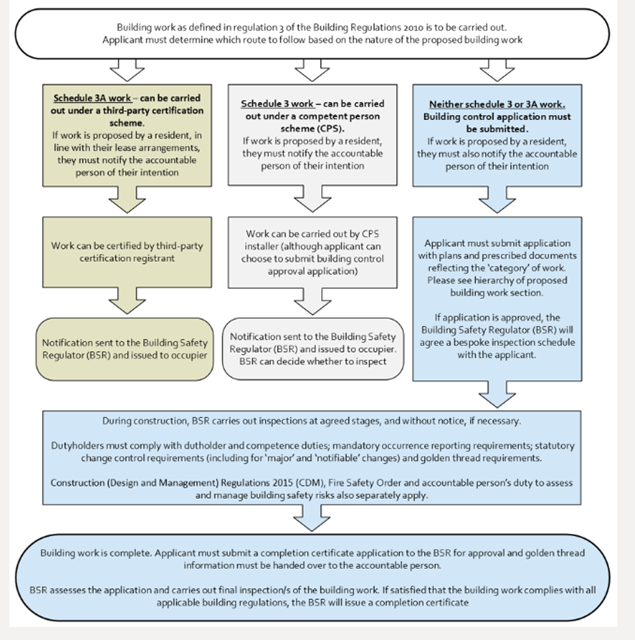
Again, the consultation paper contains very detailed comment on the proposals for work to higher-risk existing building. We recommend that the section is read in full if it is of relevance to you.
Other aspects of higher-risk building regime
Stronger change control process: Building work for higher-risk buildings will have a stronger change control process (see part 6 of the consultation). It is also proposed that there be specific processes to follow if the identity of the client, principal designer or principal contractor changes.
Regularisation of unauthorised work: Part 7 of the consultation provides for “regularisation” to apply in certain situations in relation to which certain work in higher risk buildings has been undertaken but was not notified when it should have been.
Golden thread of information: further information is given about the proposed “Golden Thread” process:
obligations on dutyholders to ensure suitable arrangements in place for the creation, management and maintenance of the “golden thread” of information for a project. The consultation paper notes that it is expected that it will be the Principal Designer who will manage the golden-thread on a day to day basis during the design phase; with the Principal Contractor doing so during the construction phase (although it is acknowledged these will overlap), with the client to have an overall high-level responsibility for ensuring arrangements are in place to create and manage the information during the design & construction process.
The Government proposes that only “relevant” information should be in the golden thread – being defined as that “supporting compliance with all applicable building regulations”, and it is proposed that guidance will be provided to assist dutyholders in identifying what documentation is “relevant” and should be included. It is also noted that information may not always remain “relevant”, such that the golden thread materials will need to be regularly reviewed.
It is proposed that the building control approval application materials will form part of the golden thread, and comment is invited on what information industry participants believe should form part of the golden thread.
It is proposed that the golden thread has to be digital – such that information and data is to be stored electronically and can be transferred electronically – but there is to be no prescribed system; albeit that the BSR will be publishing best practice guidance of how to implement the golden thread in practice. Comment is also made at part 8.36 and 8.37 about how it is anticipated information and documents will be kept up to date and accurate as the construction process progresses. It is also noted at parts 8.38 to 8.45 that whatever system(s) is used it has to be interoperable and accessible by all even if they use different software etc. Proposals are also made regarding documenting accountability for the information.
Mandatory occurrence reporting: duties will be placed on the Principal Contractor and Principal Designer after the building control approval stage to establish a mandatory occurrence reporting system and to report safety occurrences to the BSR. It is proposed that such notifications must be given to the BSR within 10 working days of the dutyholder becoming aware of the occurrence. Guidance will be provided by the BSR as to the circumstances of safety occurrences which should be reported, but this will not be a definitive list. It is likely that the reporting procedure will also be carried out via an “online digital solution” to be specified in regulation.
Enforcement and sanctions for all building work
The Government is also proposing that these new regulations will (a) provide for the procedural and administrative requirements around the use of the new “compliance” and “stop” notices provided for in the BSA; and (b) set out options in relation to building regulations which will be exempt from enforcement action.
In particular, there are currently some Building Regulations which are exempt from prosecution under s35 Building Act 1984, and the Government is considering whether or all of these should be removed from the exemption (i.e. so s35 would apply to them) – see part 10 of the consultation for more detail.
It is proposed that breach of the dutyholder’s duties and the competency requirements will be a criminal offence under s35 of the Building Act 1984.
Wider changes to the building regulations
It is proposed that changes will also be made to the building control approvals process for non-higher risk building work, including specifying that notices/approvals lapse automatically after three years if work has not started; new definitions of commencement of work for new builds and work to existing buildings (see below) ; and replacing the current deposit of plans requirement with a new requirement to submit a building control approval application before commencing work.
New definitions of “commencement of work” proposed for both higher-risk and non-higher risk building works to new and existing buildings:
- Part 11 sets out the Government’s options and proposals for defining “commencement of work” in various scenarios (which is likely to be relevant to transitional provisions). The scenarios include new builds as well as work to existing buildings (and makes specific provision for works to – among other things – replacing an external wall system (see para 11.21).
Transitional provisions in relation to new “higher risk” building regime.
Finally, the consultation paper provides some potential guidance on the Government’s proposals for transitional provisions (i.e which will govern from when the regulations will apply and to what works at that time) in relation the regulations relating to “higher-risk” buildings, as set out at part 12.
No specific comment is given in relation to other issues – such as the regulations relating to non-higher risk buildings, or to the “dutyholder” and “competency” requirements that will apply to all building works, but it is anticipated that at least the latter would be likely to be subject to the same approach, given that the dutyholders will have to implement the higher risk buildings regulations.