What is the AIA?
The EU AI Act (AIA) is the EU’s flagship new artificial intelligence regulation. The final text of the AIA was published in the Official Journal of the EU on 12 July 2024. Following its entry into force on 1 August 2024, the AIA will have a significant impact on organisations developing or using AI, both in the EU and beyond.
The AIA will place risk- and technology-based obligations on organisations that develop, use, distribute or import AI systems in the EU, coupled with high fines for non-compliance (up to EUR 35 million or 7% of global annual turnover).
How will the AIA apply?
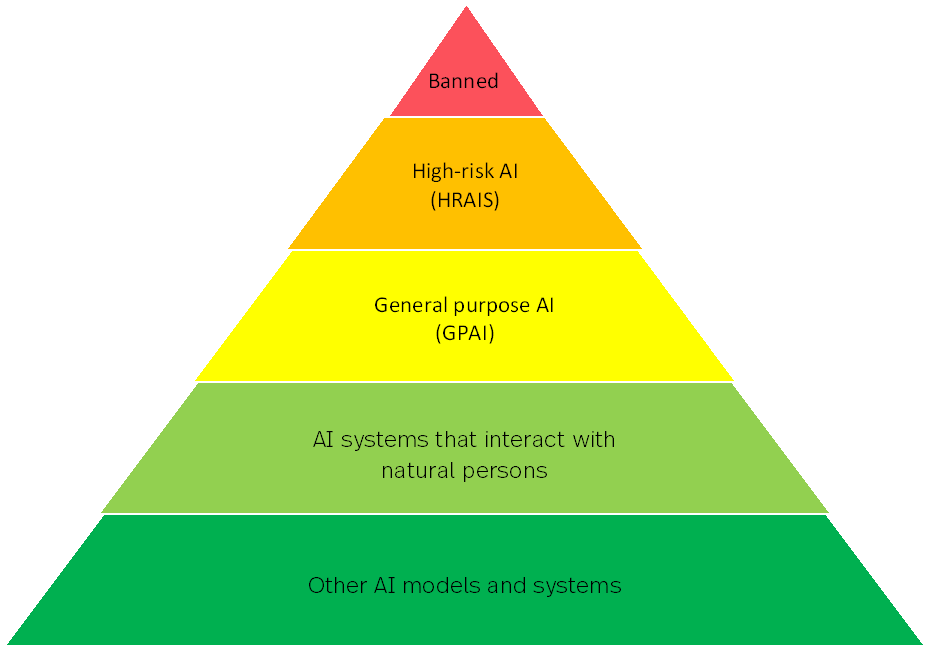
The application of the AIA depends on the AI technology involved, the use case and the role of the operator. The approach is broadly risk-based, as shown in Figure 1 here.
Figure 1: The risk-based structure of the EU AI Act.
In short:
- AI systems for certain uses will be prohibited.
- Certain AI systems will be designated as high-risk AI systems (HRAIS) and subject to extensive obligations, especially for providers.
- There will be specific provisions governing general purpose AI (GPAI) models. These models are regulated regardless of use case.
- Other AI systems are considered low risk. These AI systems will be subject only to limited transparency obligations where they interact with individuals.
When will the AIA apply?
The AIA was published in the Official Journal of the EU on 12 July 2024 and therefore enters into force on 1 August 2024 (i.e. 20 days after publication).
Most provisions in the AIA will apply after a two-year implementation period (i.e. from 1 August 2026). During this period, various supporting delegated legislation, guidance and standards will be published to assist with AIA compliance.
This 2-year timeline is subject to some important exceptions: The prohibitions on certain AI systems and requirements for AI literacy will apply after 6 months (i.e. from 1 February 2025), while the requirements for GPAI will apply after 12 months (i.e. from 1 August 2025).
Definition of AI system
Most of the obligations under the AIA concern AI systems. The definition of AI system is broad: “a machine-based system that is designed to operate with varying levels of autonomy and that may exhibit adaptiveness after deployment, and that, for explicit or implicit objectives, infers, from the input it receives, how to generate outputs such as predictions, content, recommendations, or decisions that can influence physical or virtual environments”.
Separate obligations will apply to certain general purpose AI (GPAI) models, which can underly a large range of different AI systems.
Prohibited AI Systems
The AIA will prohibit the use of certain types of AI system. The prohibitions will include (among other things):
- Certain AI systems for biometric categorisation and identification, including those for untargeted scraping of facial data from the internet.
- AI systems that deploy subliminal techniques, exploit vulnerabilities or manipulate human behaviour to circumvent fundamental rights or cause physical or psychological harm.
- AI systems for emotion recognition in law enforcement, border management, the workplace and education.
- AI systems for the social scoring evaluation or classification of natural persons or groups thereof over a period of time based on their social behaviour.
High-risk AI Systems (HRAIS)
The most onerous regulatory obligations under the AIA attach to high-risk AI systems or ‘HRAIS’. These are AI systems in areas covered by existing EU product safety legislation, as well as those intended to be used for certain purposes, particularly in the following domains:
- AI systems used as safety components in the management and operation of essential public infrastructure e.g. water, gas and electricity supplies.
- AI systems used to determinate access to education institutions or in assessing students e.g. AI systems used to grade exams.
- AI systems used in recruitment and employment e.g. for placing job advertisements, scoring candidates or reviewing job applications, promotion or termination decisions or in reviewing work.
- AI systems used in migration, asylum and border control management or in various other law enforcement and judicial contexts.
- AI systems used for influencing the outcome of democratic processes or the voting behaviour of voters.
- AI systems used in the insurance and banking sectors.
The list of high-risk AI systems is not closed and may be supplemented in future as further high-risk uses for AI emerge.
The HRAIS obligations summarised below apply principally to providers of AI systems, rather than other operators. Providers are likely to be those who develop or procure an AI system with a view to placing it on the market or putting it into service under their own name or trademark.
Other operators (including deployers, distributors and importers) are also subject to lesser obligations. Other operators may also be deemed to be providers in certain circumstances e.g. if they substantially modify a HRAIS or put it into service in their own name.
HRAIS providers will be subject to extensive substantive obligations in relation to their HRAIS, including:
- Risk management system: implementing process(es) for the entire lifecycle of the HRAIS to identify, analyse and mitigate risks.
- Data and data governance measures: training and testing of HRAIS must be undertaken in accordance with strict data governance measures.
- Technical documentation: drafting a comprehensive “manual” for HRAIS which contains specific minimum information.
- Record-keeping: HRAIS must be designed to ensure automatic logging of events including e.g. period of use, input data, and these must be kept by the providers for defined periods.
- Transparency: HRAIS must be accompanied by instructions for use which include detailed information regarding their characteristics, capabilities and limitations.
- Human oversight: HRAIS must be designed so they can be overseen by humans, who should meet various requirements e.g. being able to understand the HRAIS (‘AI literacy’) and to stop its use.
- Accuracy, robustness and cybersecurity: HRAIS must be accurate (with accuracy metrics included in instructions for use), resilient to errors or inconsistencies (e.g. through fail-safe plans) and resilient to cyber-attacks.
- Quality management system: HRAIS providers must put in place a comprehensive quality management system.
- Post-market monitoring: HRAIS providers must document a system to collect and analyse data provided by users on the performance of the HRAIS throughout its lifetime.
HRAIS providers will also be subject to various procedural obligations before they supply any HRAIS:
- CE marking: Providers must ensure their HRAIS undergoes a conformity assessment procedure before the HRAIS is supplied and affix a CE mark to its documentation.
- Registration in EU database: Providers and public bodies using HRAIS must register the HRAIS in an EU-wide database of AI systems.
- Reporting obligations: HRAIS providers must report serious incidents or malfunctioning involving their HRAIS to a relevant authority within 15 days.
Other operators of HRAIS will be subject to more limited obligations, such as to complete fundamental rights impact assessments, ensure they use the HRAIS in accordance with its instructions of use, to monitor the operation of the HRAIS and to keep a record of the logs generated by the HRAIS (if under their control).
General Purpose AI
AI technologies which are not prohibited or high-risk will be subject to much less onerous regulatory requirements.
The most onerous other requirements under the AIA attach to general purpose AI (GPAI). The requirements for most GPAI models, which includes foundation models and generative AI models, are chiefly focused on transparency.
The obligations for all GPAI will include issuing technical documentation, compliance with EU copyright law and providing summaries of the training data.
The final text includes additional requirements for GPAI that is trained on extensive data sets and exhibits superior performance; this is based on the potential systemic risks that these AI models may pose across the value chain (GPAI with systemic risk).
Any GPAI model with systemic risk will be subject to additional requirements that are expected to include:
- Stringent model evaluations, including adversarial testing/red-teaming.
- Assessing and mitigating possible systemic risks from use of the GPAI.
- Greater reporting obligations to regulators, particularly where serious incidents occur.
- Ensuring adequate cybersecurity for the GPAI with systemic risk.
- Reporting on the energy efficiency of the GPAI.
Other AI systems
Save for the above, and where two specific exemptions apply (military or defence; research and innovation), the only binding requirement for other AI systems is a limited obligation of transparency: providers must ensure that AI systems that are intended to interact with individuals are designed and developed in such a way that individual users are aware that they are interacting with an AI system.
There is, however, a general obligation on all deployers and providers of AI systems to ensure that their staff that deal with the operation and use of AI systems have sufficient AI literacy. The appropriate level of AI literacy depends on the education, expertise and technical knowledge or staff, as well as the context in which the relevant AI systems are to be used.
Financial penalties
The penalties that will apply under the AIA are expected to be very significant, ranging from €7.5m (or 1.5% global annual turnover) to €35m (or 7% global annual turnover) for the preceding financial year, depending on (i) the type of infringement and (ii) the size of the company.



_11zon.jpg?crop=300,495&format=webply&auto=webp)



_11zon.jpg?crop=300,495&format=webply&auto=webp)






_11zon.jpg?crop=300,495&format=webply&auto=webp)


_11zon.jpg?crop=300,495&format=webply&auto=webp)