Oppositions (12) – The appeal preliminary opinion
Prior to appeal oral proceedings the Board of Appeal usually issues a preliminary opinion setting out its current views on the case, and topics to be discussed.
The preliminary opinion in an appeal is similar to the preliminary opinion in opposition, but with the important difference that it does not include an opportunity to file new requests or new arguments. The parties are free to make further written submissions in preparation for the oral proceedings, but to the extent they include new requests or arguments admissibility must be considered.
At this stage of the proceedings (which the EPO term the third stage of convergence) the starting point is that new requests or arguments will not be taken into account. Exceptional circumstances and good reasons are required. The meaning of exceptional circumstances is left open, but an important situation that it does not include is a change of view expressed for the first time in the preliminary opinion. For example, if an objection to novelty was raised in the notice of opposition, but throughout proceedings this had been dismissed only to change in the preliminary opinion a new request to attend to that objection is very unlikely to be admitted. This is because the Patentee was aware of the objection from the start and could have submitted the request earlier (even though the Patentee would argue there was no need to as everything had gone their way). This is in direct contrast to the opposition process where a change of view is a reason for late admission. This emphasises the importance of making a full set of requests during opposition, even if a Patentee hopes they will not be necessary.
The preliminary opinion may be issued at the same as the summons to oral proceedings, but the approach of the Boards of Appeal seems to be increasingly to issue a summons well in advance, and then a preliminary opinion closer to the proceedings.
In view of the limited opportunity to make new requests, the parties' options after the preliminary opinion are somewhat limited, and arguably no action is required. However, it is likely to be useful to make well-reasoned submissions in relation to any points against a party so that the board has those in mind when preparing for the oral proceedings and avoids them being taken by surprise on the day.
The preliminary opinion also marks one of the changes in the amount of the appeal fee that is refunded if the appeal is withdrawn. Such refunds follow a fairly complex path as shown in the following figure (for more detail on EPO appeal fee refunds, see our earlier article here.
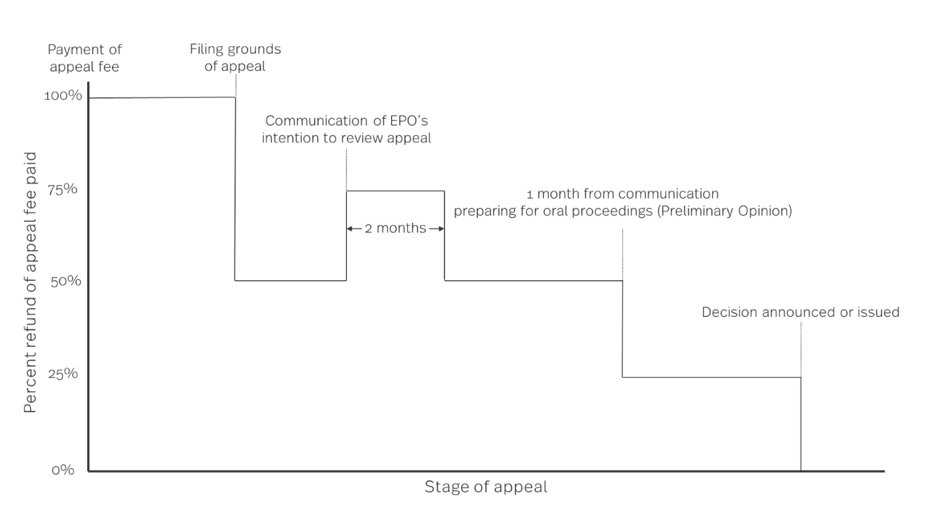
After the grounds of appeal are filed a 50% refund is available, which increases to 75% for two months if the board of appeal indicates they will start examining the appeal. The refund amount then decreases to 25% one month after the preliminary opinion is issued. It is therefore beneficial to review the preliminary opinion and confirm the intention to continue with the appeal as a larger refund can be obtained if the appeal is withdrawn promptly.
If there is only one party to an opposition appeal and they withdraw their appeal, the appeal proceedings are automatically terminated, and the opposition decision will become final. If there are other parties, the withdrawing party becomes a party as of right and can continue arguing their position but within the constraints discussed previously for a party as of right.
The next stage in the appeal process is the oral proceedings, which will look at next week.
This article is a part of our EPO Practice and Peculiarities series. Click here to explore.







_11zon_11zon.jpg?crop=300,495&format=webply&auto=webp)


_11zon.jpg?crop=300,495&format=webply&auto=webp)



.jpg?crop=300,495&format=webply&auto=webp)


.jpg?crop=300,495&format=webply&auto=webp)