Consumer IoT - Preliminary findings of the EU Commission published
On 9 June 2021, the EU Commission published its preliminary findings of the sector inquiry it has been conducting since 16 July 2020 on the IoT sector.
On 9 June 2021, the EU Commission ("Commission") published its preliminary findings of the sector inquiry it has been conducting since 16 July 2020 on the consumer Internet of Things ("IoT") sector.
This sector inquiry fits into the broader context of the Commission's digital priorities. The Commission has been trying to accelerate the development of the IoT in the EU and notably published in 2017 a staff working document, "Advancing the Internet of Things of Europe", which specifies the EU's IoT vision. In that context, the Commission's objective with the sector inquiry is to get a better understanding of potential competition concerns that might distort competition in this sector.
What is the scope of the sector enquiry?
Due to an increasing number of devices becoming "smart", the acronym "IoT" comprises a wide range of products and services. However, the sector enquiry focuses on the consumer IoT environment, ie on products and services that are integrated into consumer-oriented offerings. Industrial IoT is not part of the study, as well as connected cars which are considered as having distinctive regulatory and factual characteristics. As a result, the study covers for instance the following products and services: voice assistants, smart home devices, wearable devices (eg health and fitness trackers), etc.
As part of its inquiry, the Commission interrogated more than 200 companies active in the sector and reviewed over 1000 agreements. The data gathered shows that the IoT sector is relatively new but is growing rapidly: worldwide revenue in the sector is expected to grow from €107.2bn in 2019 to €408.7bn by 2030.
While the use of consumer IoT products is spreading quickly across EU consumers, the GAFAM remain at the centre stage. Indeed, the leading voice assistants are Amazon's Alexa, Google's Google Assistant and Apple's Siri and the leading operating systems for smart mobile devices, which are of key importance in the consumer IoT sector, are run by Google and Apple.
Market players have also indicated that they face important barriers to entry and to expansion including technology costs, competitive pressure, lack of interoperability with some devices or technologies, the existence of proprietary technologies, etc.
Consequently, even if the level of competition hugely varies depending on the relevant products or services, the respondents have indicated that they face difficulties to compete with Google, Amazon and Apple which are considered as "must have".
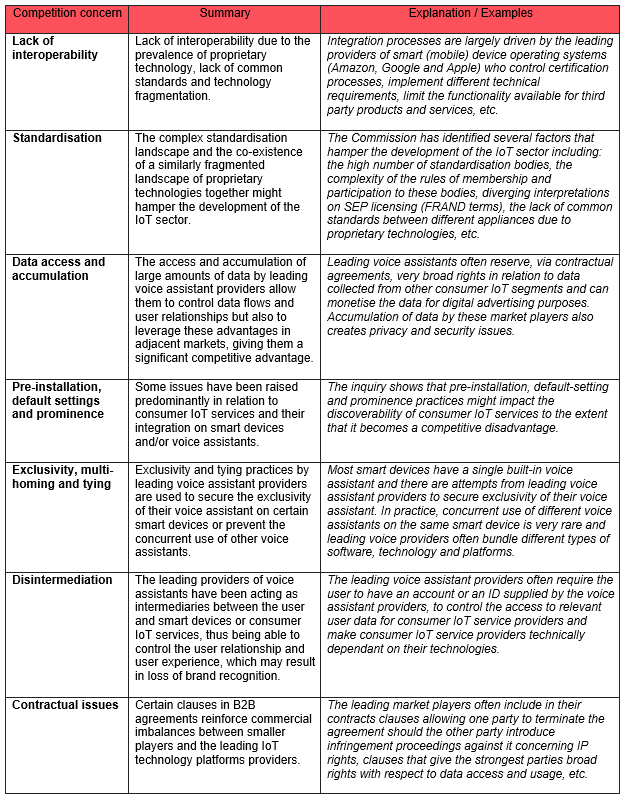
What competition concerns has the Commission identified at this preliminary stage?
What are the three things to remember for companies active in the consumer IoT sector?
The Commission's preliminary report contains a wide range of data collected from businesses and stakeholders. The three key points coming out of the Commission's report are:
Google, Apple and Amazon which provide the most common smart and mobile device operating systems and the leading voice assistants have significant competitive advantages, are leaders in most relevant markets, and may leverage their existing position into adjacent markets, while other market players face important barriers to entry and to expansion (eg costs of technology, access to data, lack of interoperability, etc);
Several competition concerns have been identified (eg lack of interoperability, exclusivity and tying practices, etc). They should be carefully monitored by stakeholders, since they could lead to further investigations by the Commission and/or national competition authorities; and
The Commission has launched a public consultation that will close on 1 September 2021. The answers to the public consultation will be used in the Commission's final report, expected in early 2022, but might also be used in the context of ongoing discussions on the Digital Markets Act and the Digital Services Act.


_11zon.jpg?crop=300,495&format=webply&auto=webp)









_11zon.jpg?crop=300,495&format=webply&auto=webp)


_11zon.jpg?crop=300,495&format=webply&auto=webp)



_11zon.jpg?crop=300,495&format=webply&auto=webp)