Synthetic securitisation: opening the Basel toolbox in Asia-Pacific
Banks in Asia-Pacific are considering how the Basel toolbox can best be used to help bring benefits and efficiencies to their balance sheets.
The Basel framework has long provided a range of tools to help banks manage their balance sheets. These include tools such as internal models and credit risk mitigation. The tools may serve a range of functions, including general risk mitigation, regulatory capital relief, large exposure reduction, creation of liquid assets and managing asset and liability maturity mismatches. One such tool, which has been a growing feature in the US and European markets over the last five or six years has been synthetic securitisation - and banks in Asia-Pacific are now starting to take note of this tool and consider how it can best be used.
A synthetic securitisation can best be described as a transaction where a bank which has a portfolio of loans (or other financial assets) buys credit protection against one or more tranches of risk in that portfolio, whilst remaining the legal owner of the portfolio. Let’s take an example - a portfolio of 1,000 SME loans of equal size held by a bank. The bank may agree that the first 5 of losses in the portfolio are allocated to the bank, the next 95 to an investor or investors and then anything beyond that (ie, the remaining 900) to the bank.
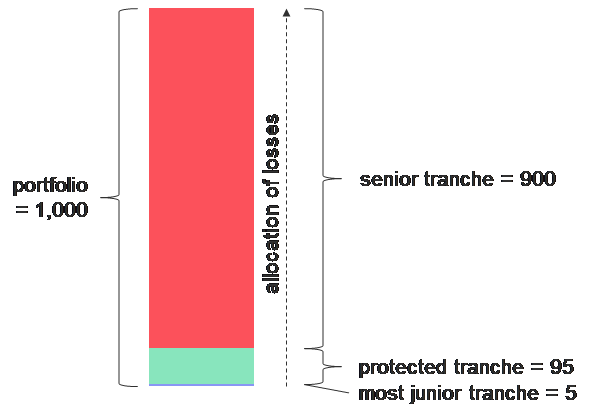
The credit protection might take a number of forms. For instance, an investor may provide a guarantee or a credit default swap referencing the portfolio directly to the bank. Guarantees or credit default swaps might also be collateralised by the investor. Alternatively, the bank could issue a credit-linked note which references the portfolio. The use of special purpose vehicles (SPVs) in these structures is also common where an SPV provides, on the one hand, the guarantee or credit default swap to the bank and issues, on the other hand, notes to investors and uses the proceeds of those notes as collateral to support its obligations under the guarantee or credit default swap.
But all of these forms of credit protection achieve the same commercial effect for the bank - protection against losses which are allocated to the protected tranche. The investors which most commonly agree to accept the risk of losses on the protected tranche include entities such as hedge funds, pension funds, family offices, sovereign wealth funds, public sector entities (eg, EIF, BBB, KfW) and credit insurers - and they are paid a high margin on their investment for doing this.
Regulatory Benefit
There are two core regulatory benefits which a bank will achieve by undertaking a synthetic securitisation:
- as part of its general credit risk management strategy, the bank’s credit risk in the portfolio loans will be significantly reduced and:
- provided the relevant criteria are satisfied, the bank will no longer need to hold regulatory capital against the underlying assets in the portfolio, but instead hold (usually significantly less) regulatory capital against the tranches in the synthetic securitisation that it retains (typically the most senior tranche and, in some cases, also the most junior).
As a portfolio management technique, synthetic securitisation is often a much cheaper option for a bank compared to issuing new regulatory capital or disposing of assets in order to manage its existing regulatory capital. A synthetic securitisation also allows a bank to entirely retain its existing relationships with its customer which owe the underlying exposures - there is no need for the customers to be aware of the synthetic securitisation. There is no assignment or other transfer of the underlying exposures in contrast to, for example, a traditional securitisation which involves a sale of the underlying exposures to an SPV. The absence of an assignment or sale also means synthetic securitisation is seen as a valuable tool where there are portfolios of assets which it may be difficult to transfer – eg, because the assets contain stringent prohibitions on assignment, are in jurisdictions which have strict exchange control rules, require further advances to be made or are in a variety of jurisdictions with different transfer regimes. Synthetic securitisations also tend to be far faster to execute that traditional securitisations.
For these reasons, the most common asset classes to be included in synthetic securitisations tend to be corporate loans, SMEs and trade finance. However, commercial real estate loans, infrastructure and project loans, consumer debt and auto loans are now becoming increasingly common.
Basel Framework
The synthetic securitisation rules within the Basel framework have been a part of the European regulatory framework for many years, currently set out in the Capital Requirements Regulation (Regulation (EU) 575/2013).
There are also existing Asia-Pacific implementations of the Basel synthetic securitisation rules in both Hong Kong and Singapore. In Hong Kong they are found in Part 7 of the Banking (Capital) Rules (Cap. 155L) and in Singapore they are found in Part VII and Annex 7AD of Monetary Authority of Singapore Notice 637.
In the recent Banking (Capital) (Amendment) Rules 2020, the Hong Kong Monetary Authority updated the Hong Kong synthetic securitisation rules to bring them fully up-to-date with Basel and the European rules, explicitly permitting the use of SPVs as providers or guarantees and credit default swaps from June 2021. Once effective, the full spectrum of synthetic securitisation structures available in Europe would be available for use in Hong Kong.
Use for synthetic securitisation in Asia-Pacific
It is true that banks in Asia-Pacific are well capitalised - the average regulatory capital to risk weighted assets ratio in Hong Kong is over 20% and in Singapore it is over 17%, compared to, for instance, the United States, where it sits at around 14% or Spain, at around 15% (figures from the IMF). However, even in other jurisdictions with well capitalised banks, such as the UK (21%) and Germany (18%), synthetic securitisations are very much the norm, helping banks run efficient and healthy balance sheets.
But aside from regulatory capital, there are some specific risk mitigating effects which banks in Hong Kong and Singapore are looking to achieve with synthetic securitisation. For instance, a Hong Kong bank with a portfolio of Chinese corporate loans cannot easily undertake a traditional securitisation of those loans due to exchange control and customer relationship considerations; however, a synthetic securitisation is very easy and can be put in place regardless. Or a Singapore bank with an exposure to project finance loans may struggle to do a traditional securitisation, or even traditionally distribute, those loans due to assignment prohibitions and confidentiality restrictions; however, these loans can be packaged into a synthetic securitisation for that bank.
For these reasons, synthetic securitisations in Asia-Pacific look set to have more of a jurisdiction-focus or sector-focus to the assets which are included within them. This will provide much opportunity for investors looking to diversify their investments and help bring benefits and efficiencies to banks regulated in Asia-Pacific.


.jpg?crop=300,495&format=webply&auto=webp)



.jpg?crop=300,495&format=webply&auto=webp)
.jpg?crop=300,495&format=webply&auto=webp)


.jpg?crop=300,495&format=webply&auto=webp)


_11zon.jpg?crop=300,495&format=webply&auto=webp)