DFSA to become Signatory to the IOSCO Enhanced MMoU
The DFSA strengthens its global positioning amongst regulators.
The Dubai Financial Services Authority (DFSA) announced on 28 January 2020 that it has been accepted by the International Organization of Securities Commissions (IOSCO) as a signatory to their revised enhanced cooperation agreement. This makes the DFSA the first regulatory authority in the Middle East and Africa to become a signatory to the revised agreement.
Background
IOSCO, which was first established in 1983, is an international body made up of securities regulators in more than 115 jurisdictions globally. It promotes collaboration between regulators and sets international standards for securities regulation, oversight and enforcement. IOSCO members exchange information among themselves and cooperate on enforcement against misconduct and the supervision of markets. Its goal is to enhance investor protection and confidence in the markets and help maintain fair, efficient and transparent markets whilst minimising systemic risks. The IOSCO Objectives and Principles of Securities Regulation have been endorsed by the G20 and the Financial Stability Board as the relevant standards in this area.
In 2002, the initial Multilateral Memorandum of Understanding Concerning Consultation and Cooperation and the Exchange of Information (MMoU) was established. This provides a framework for regulators to cooperate, consult and exchange information for regulatory enforcement for their respective securities markets. The scope of the MMoU encompasses combatting, among other things, insider dealing and market manipulation, misrepresentation of material information, and fraudulent or manipulative market practices in relation to securities and derivatives, including activities of market intermediaries like investment or trading advisers who are required to be licensed or registered, collective investment schemes, brokers, dealers and transfer agents. The MMoU sets specific requirements for the type of information that can be exchanged and the means of doing so, legal capacity to compel information sharing, and permissible use of such information. In particular, the framework aims to ensure that there are no domestic laws that would prevent regulators from exchanging relevant information with their international counterparts.
Since 2005, there has been a push from IOSCO to increase the number of signatories to the MMoU. Over the years, IOSCO have put in place incentives to compel its members to become signatories, including publishing a watchlist of those members who have not yet become signatories online and limiting their decision-making powers within IOSCO.
Recent Developments
In order to address the changing market in the light of increased globalisation and interconnectedness of financial markets, as well as advances in technology, IOSCO found that enhanced information sharing and cooperation between its members would be necessary going forward to safeguard market integrity and stability, protect investors and deter misconduct and fraud. IOSCO has therefore established a new Enhanced Multilateral Memorandum of Understanding (EMMoU) in 2016.
The EMMoU provides inter alia for the following additional powers:
- obtaining and sharing audit work papers and related documents;
- ability to compel physical testimony;
- freezing assets; and
- obtaining and sharing existing internet service provider and telephone records.
While the EMMoU and the MMoU will initially co-exist, it is the ultimate aim for all signatories to migrate to the EMMoU.
Impact Assessment
The DFSA is the first regulator in Africa and the Middle East and only the third regulator from IOSCO’s 111 emerging markets jurisdictions to be accepted for migration to the new EMMoU. This is following significant scrutiny of the DFSA’s legislative and regulatory regime as well as its enforcement powers and willingness to use them in practice.
The early accession should help to increase the DFSA’s profile among global regulators and allow it to foster a closer relationship with them in the context of the additional cooperation and information sharing required under the EMMoU.
The chart below from IOSCO shows the growing number of MMoU information exchange requests over recent years across all signatory regulators:
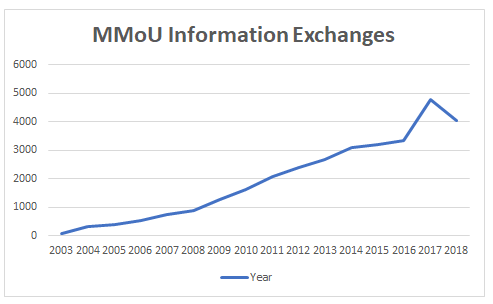
Source: Iosco
There was a particularly noticeable increase in the number of information exchange requests in 2016, when the new EMMoU regime was introduced. This suggests that regulators globally are increasingly availing themselves of the enhanced powers under the new regime.
For more information on the EMMoU or IOSCO more generally, please contact Muneer Khan or Nina Fischer.